Differentiation, as said in the other file, is finding the gradient.
Specifically, it’s about finding the gradient of a tangent line to a graph. Tangent lines are lines that intersect the graph at only one place like this:
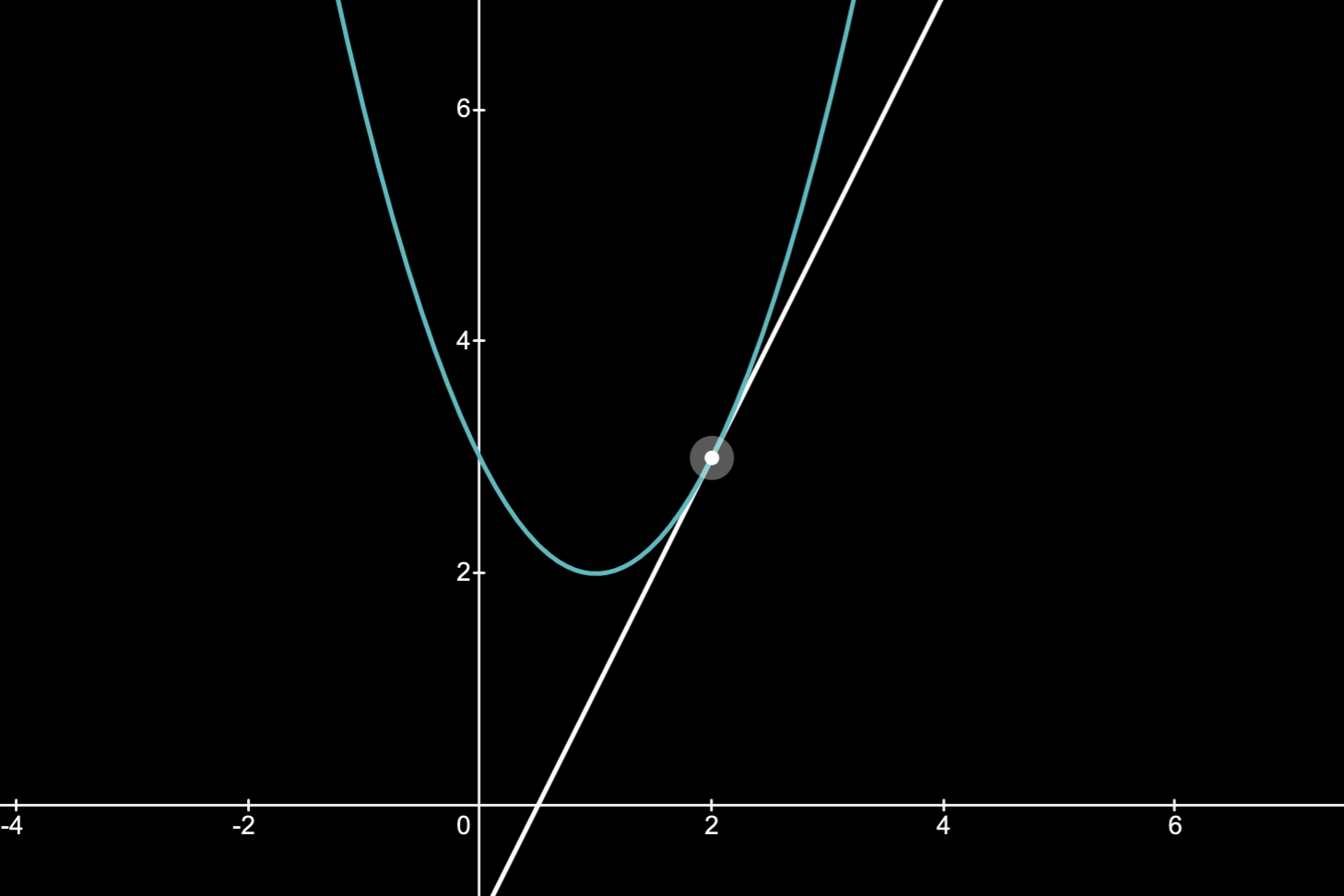
Gradient of a Tangent
Finding the gradient of a tangent involves the knowledge of ‘The First Principle’. Although this is a Level 3 knowledge, it’s essential understanding how differentiation works, rather than memorizing formulas.
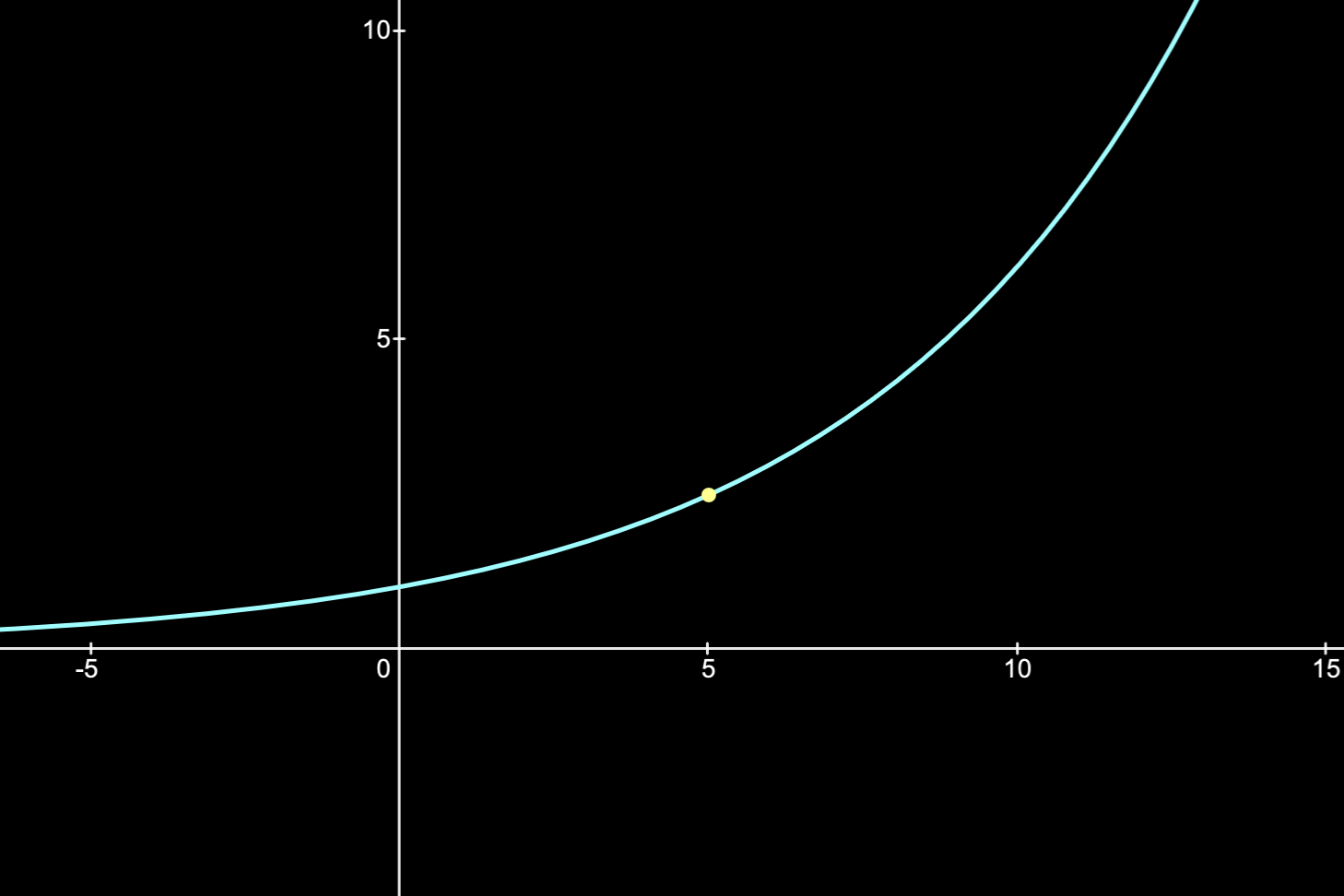
Lets say we have a function like this (it can be any other function), and we want to find the gradient at when (at the yellow point). However, we have learnt from L2 Coordinate Geometry that you need at least 2 points to find the gradient of a line using the following formula:
So, what we’re going to do is plot another point on the graph:
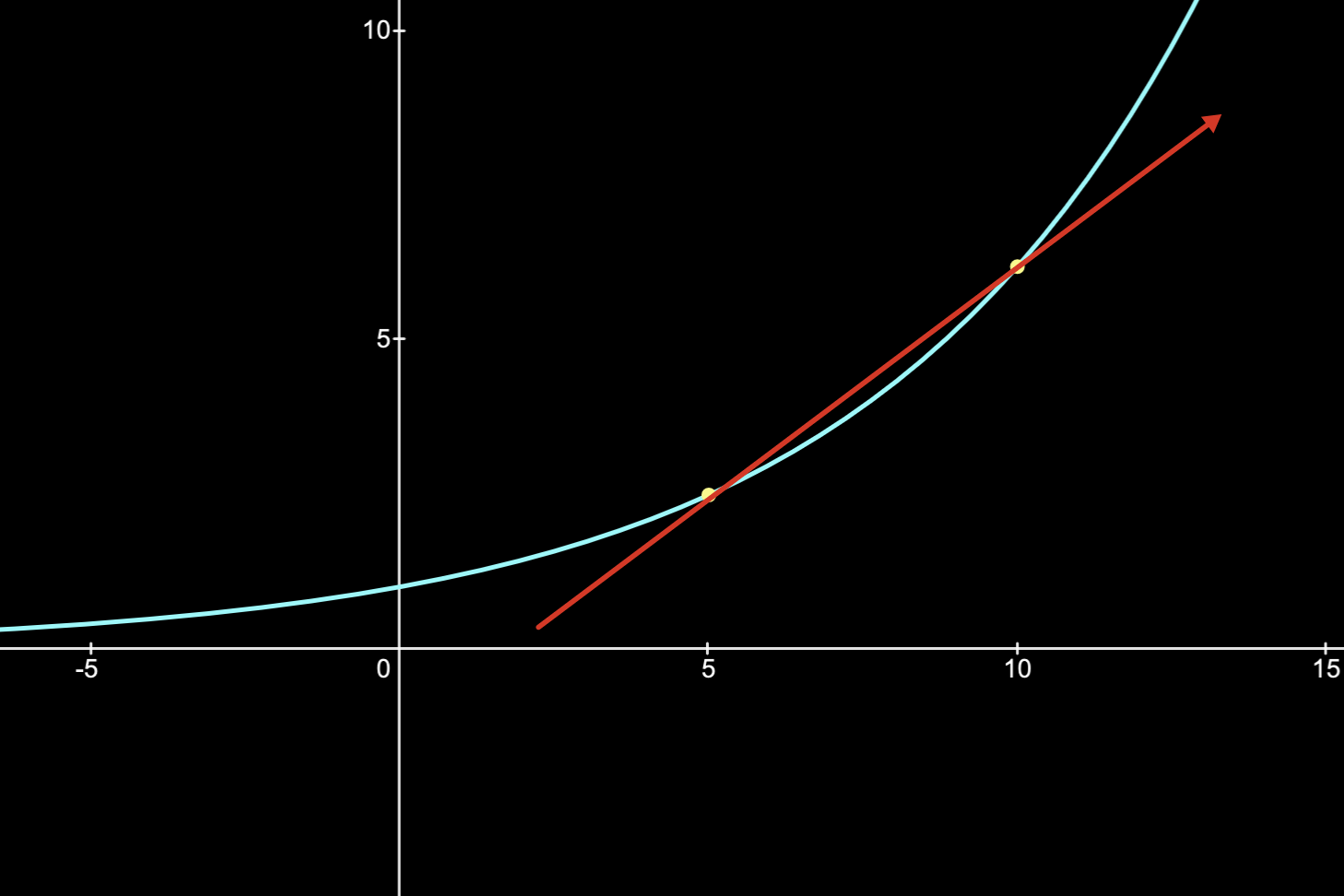
Since we have 2 points, we can draw the line, and we can find the gradient of the red line. However, differentiation is about calculating the gradient of a tangent line, not a line that intersects the graph twice.
A tangent line requires the line to intersect the graph at only one point only. However to find the gradient, we must have 2 points. This is where ‘limits’ come in.
Limits
Although limits is a Level 3 content, without limits, differentiation cannot exist.
Limits look like the following notation:
We say this as “as approaches zero”. This is basically like an asymptote line. will approach zero, but will never reach zero.
Another instance,
This is “as approaches infinity”. will consistently get bigger, as it is approacing .
Going back to the question, and ignoring the axis numbers, lets make the yellow dot on this diagram be have the -coordinate of :
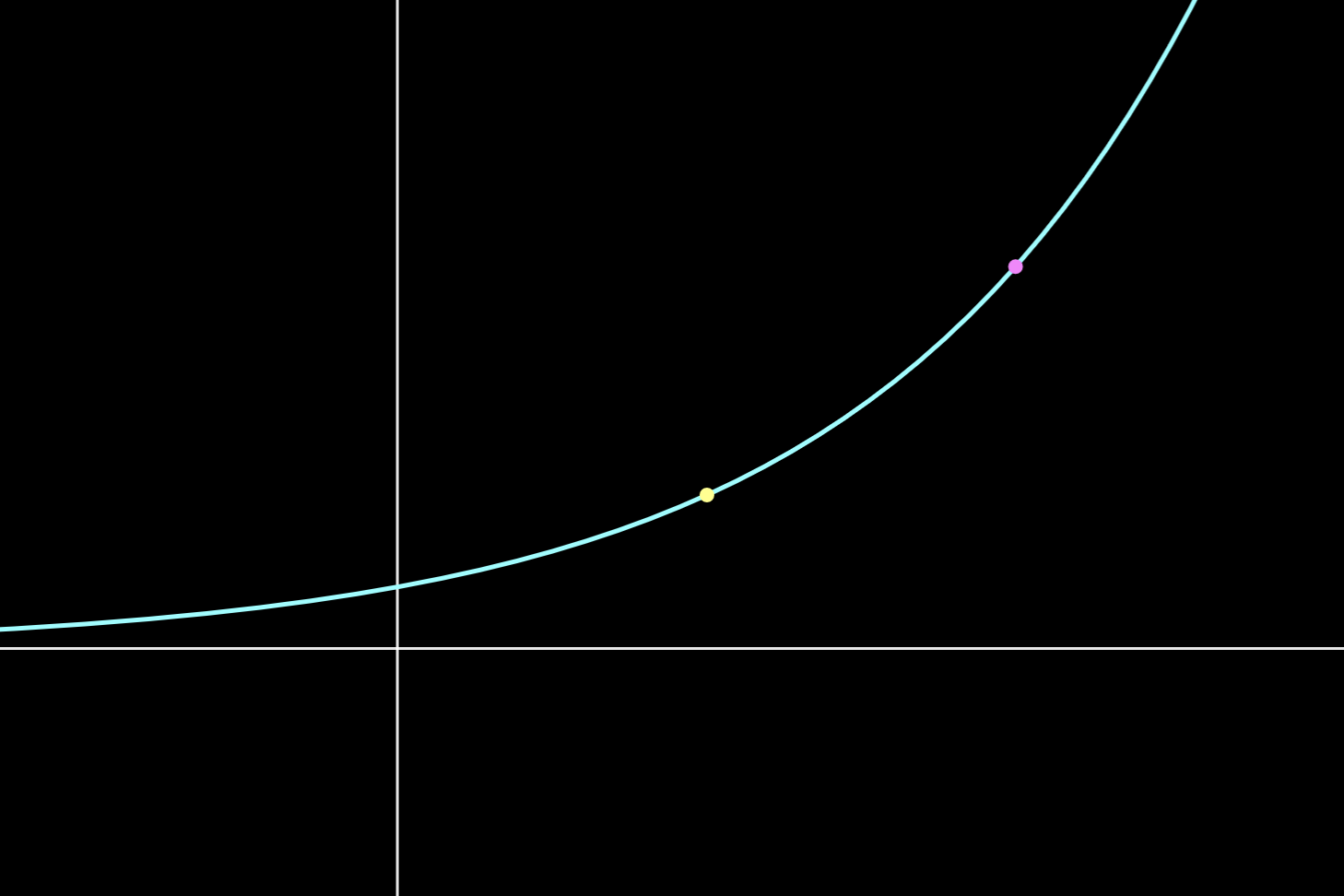
Using idea of functions, the -coordinate of the yellow dot will be . Therefore, the yellow point will have the coordinates .
Now, lets let the horizontal distance between the yellow point and the pink point be . This will mean that the -coordinate of the pink point will be , and the -coordinate would be . Therefore the pink point will have the coordinates like this:
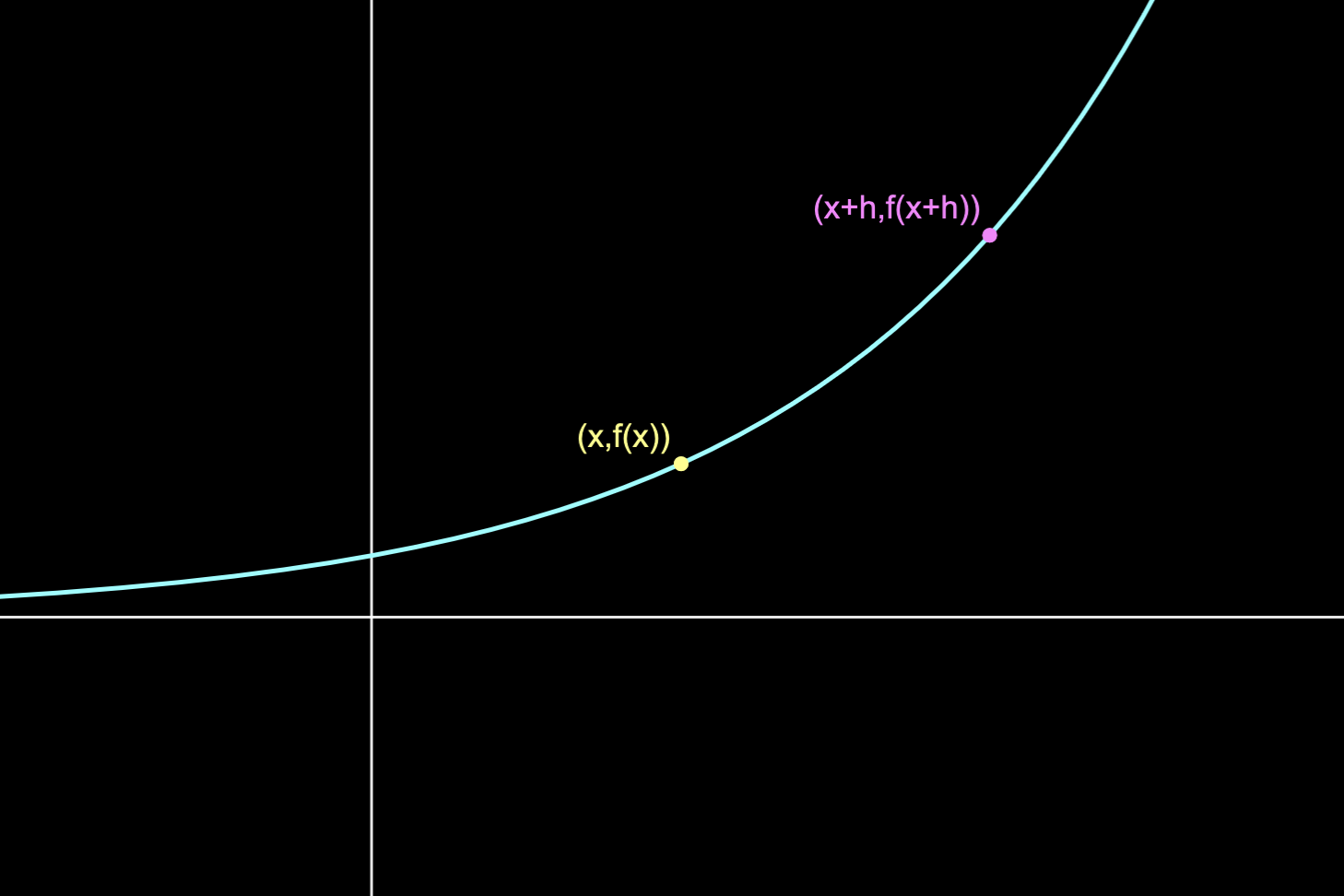
Now, lets apply our knowledge from coordinate geometry, using the gradient formula of:
If we let , , , ,
we will get the following equation:
However, we need the gradient of a tangent. So, this is where limits come in.
We have defined the horizontal distance between the yellow and pink points to be . Lets use limits, to make approach zero.
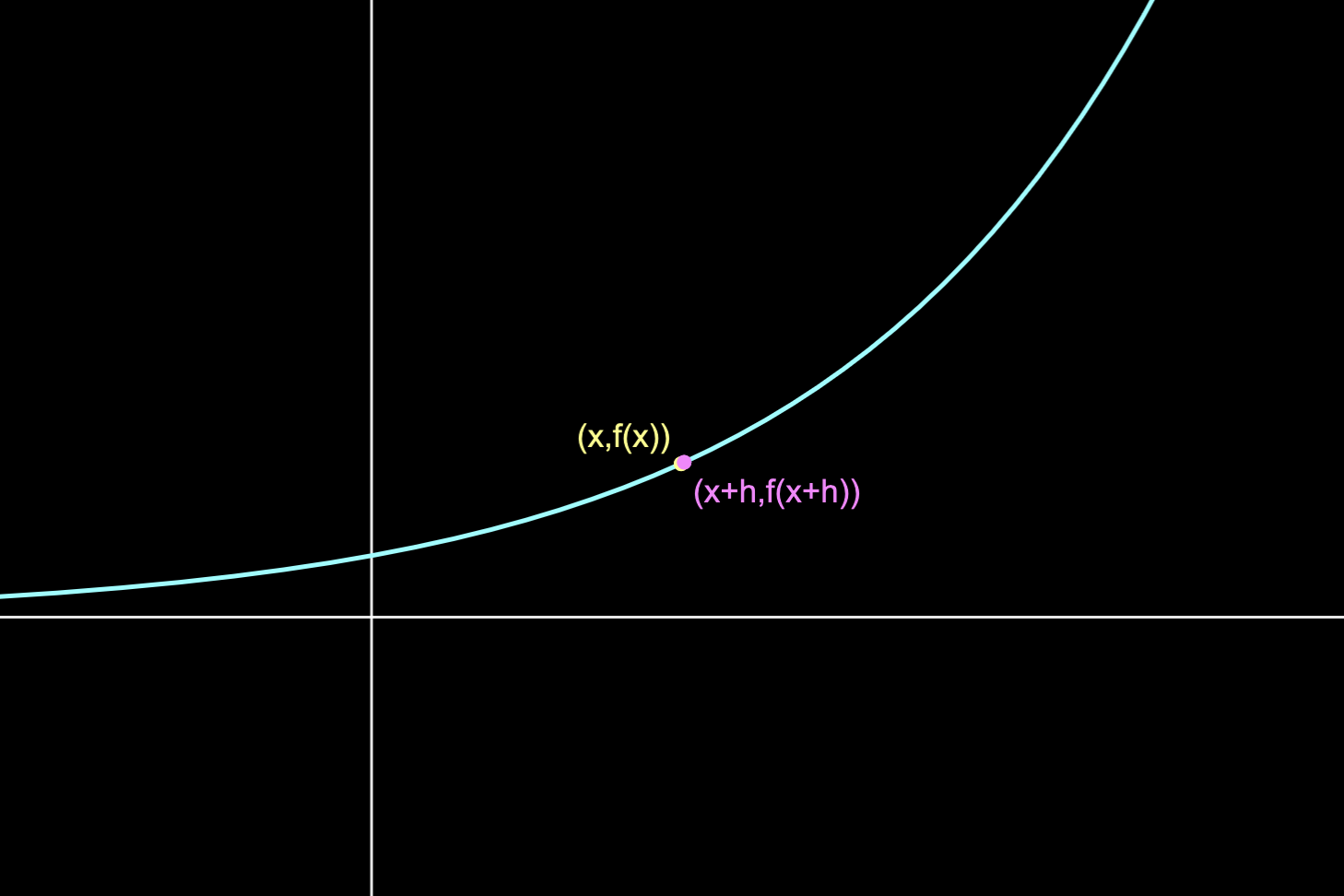
It would look very similar to this. This means that we have two points on the graph that can make a gradient, but the points are so close to each other that we can deem it as being one point.
Now, we add the limit notation to the gradient formula:
We call the above boxed formula, “The First Principles of Differentiation”.
Now, instead of calling the gradient, the “Gradient” as seen from the boxed formula, we call this the Derivative, noted as , or .
You can choose which expression to use between and , in Level 2. However, in Level 3 Calculus, you’ll be strongly advised to use .