An exponential equation is basically the inverted function of a Logarithmic Function; exponentials are related to logarithmics.
All exponential equation has an unknown exponent — for example: (graph below)
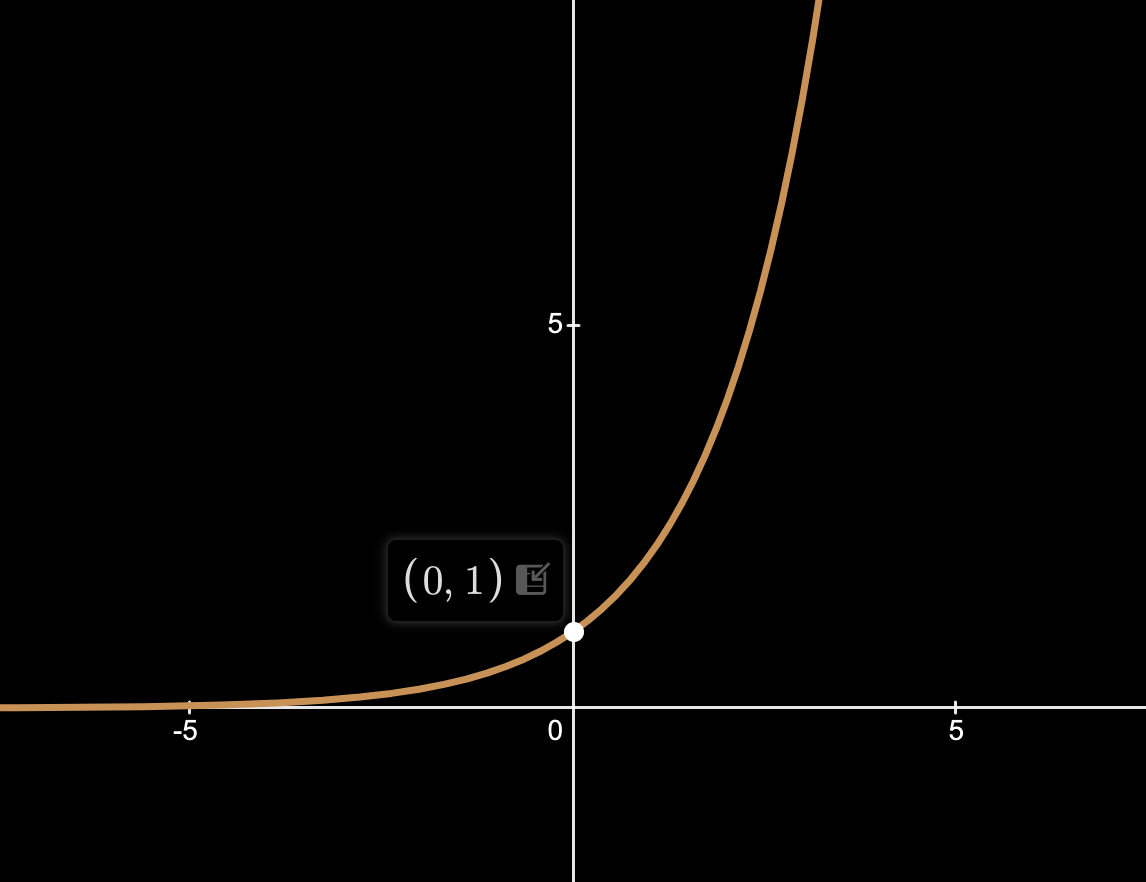
the generic equation is:
..where you can translate the graph by modifying the and coordinates.
By modifying the value of , you can translate the graph along the axis,
..and by modifying the value of , you can translate the graph along the axis.
Tip: If you don’t have an idea of what a graph might look like, draw a table of coordinates ( and pairs) because it will then tell you the points of the graph which then you can connect the points.
is the scale factor of the function, where if you increase it, the function turns into a more steep slope.
However, cannot be lower, or equal to 1, as it would make the graph linear, or undefined.
The asymptote is a boundary of the exponential function, described as “a line that goes near, but never touches”. All exponential functions have (a) asymtote(s). In the graph above ( ), the asymptote is .
You might be able to see a connection between on the generic equation and the asymptote. Yes, the asymptote of a exponential function is the value of .