This exam is about either tracing, or making your own paths of an image/map using mathematical graphs, and explaining them in words. Normally you are allocated up to three hours for this exam. I ran out of time myself (but I still got excellence L), because drawing them took ages.
Must talkabout(s) in the exam:
You should talk about minimum three of these in the exam (go with four/five as safety).
-
Domain “” The set of possible -values which are valid for the context
-
Range “” The set of possible -values which are valid for the context
-
Symmetry (if any) Describe any reflection lines i.e. give the equation of lines of symmetry
-
Turning/inflection points (vertex), local max/min points (if any) State any stationary point and give their coordinates
-
Intercepts (if any) Write down the values of the and intercepts. -intercept at i.e. the value of when is 0. -intercept(s) at i.e. the value of when is 0. schools normally don’t like it when the intercepts, or coordinates are like a never-ending decimal such as , and yes, I got flagged for it. when picking intercepts, try to use a good point (I refer to this as perfect points) like .
-
Asymptotes (if any) An asymptote is a line (value) that approaches a curve (equation) but doesn’t get to. E.g. value causes the equation to divide by zero. If there are asymptotes, write down their equations.
EDIT: You also have to talk about why you have used them.
For example, if you were to trace this path:
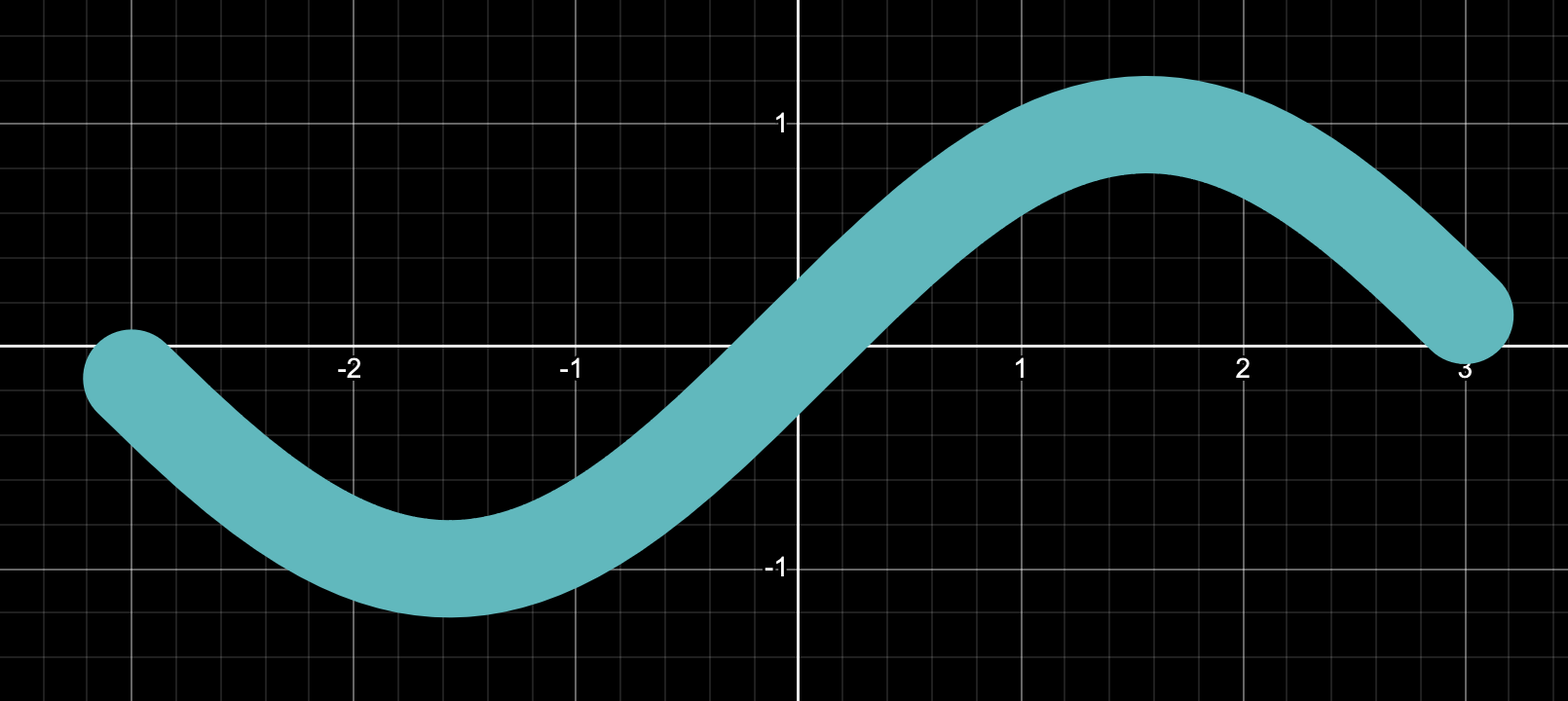 You could say that:
“Since this path has a wave-looking shape, I could use a sine graph since sine graphs also have a wave-looking graph.”
Use graph created below to find all the MRT/EXC criteria: https://www.desmos.com/calculator/hwiengmumv