Every complex number that we’ve used, in the form of is expressed in the ‘rectangular form’.
There is one more form in Complex Numbers — known as the ‘polar form’. This consists of using , and the angle between the positive real axis, and the modulus line.
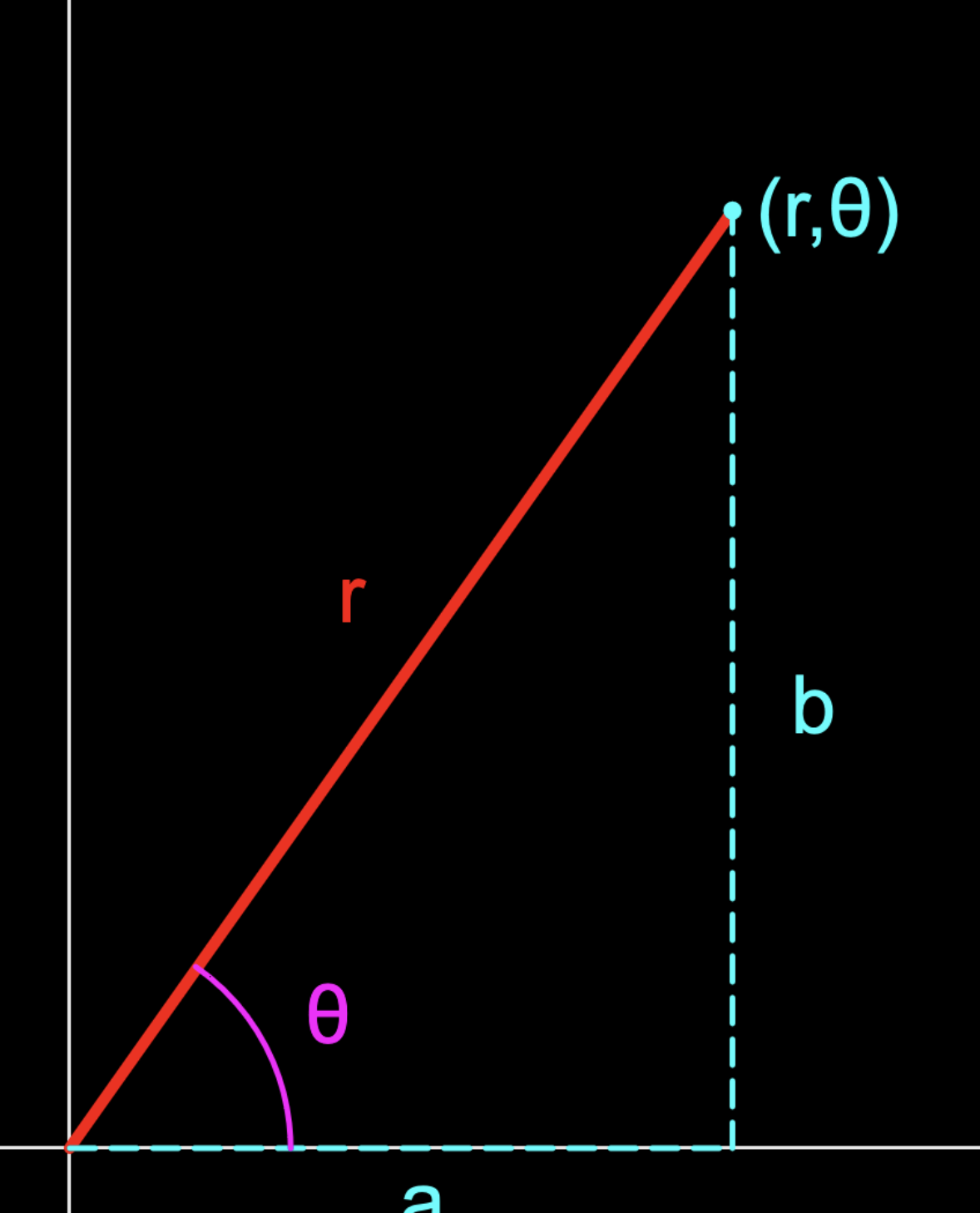
For the image above, we can see that is the modulus, and is the angle between the positive real axis, and the modulus line.
The point ‘s argument is , and can be expressed as .
Using triginometry, we know that the side (adjacent), and (opposite) are respectively , and .
However, using the Argand diagram we know that the vertical is imaginary, and therefore would be .