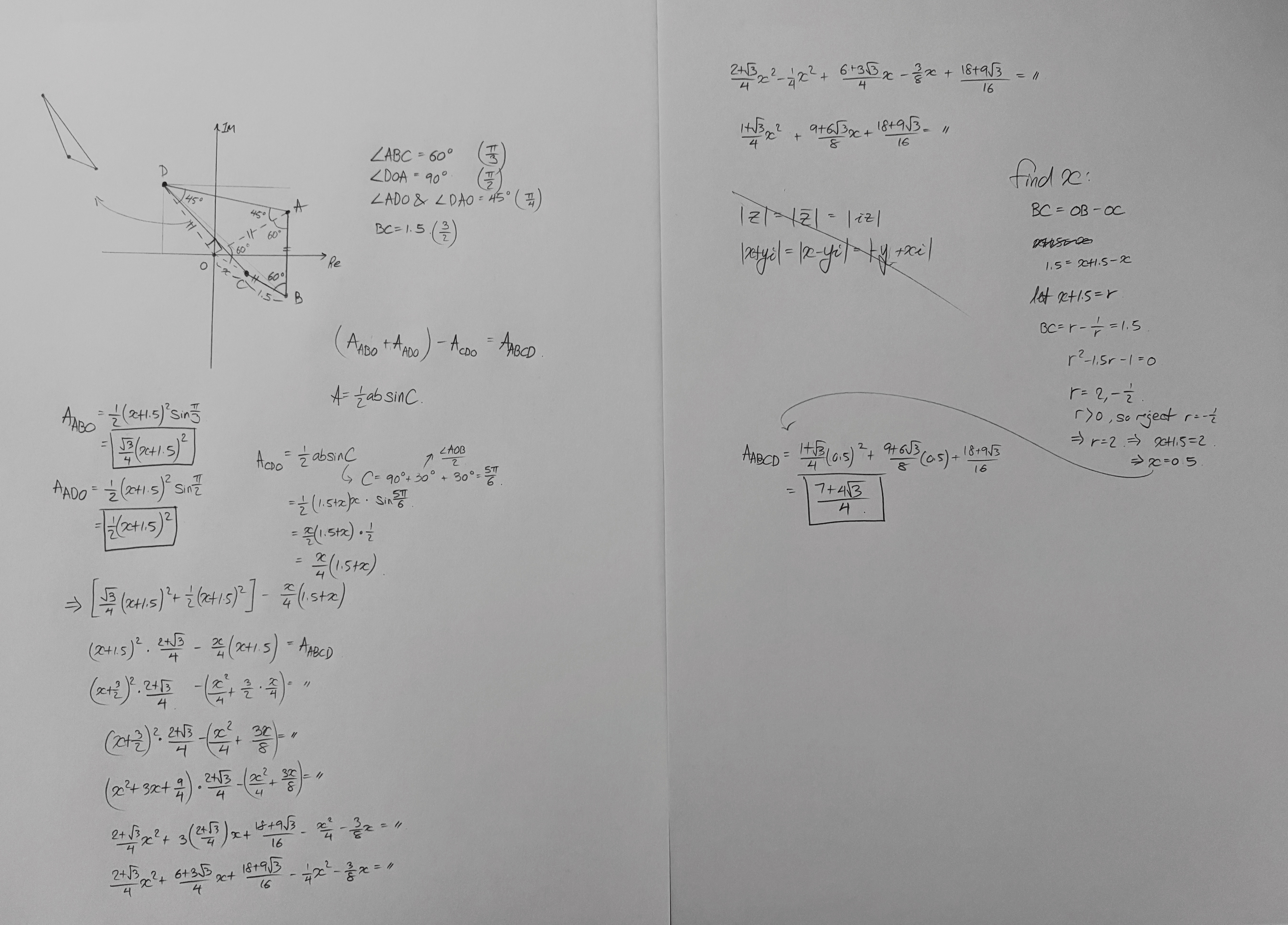
SCH_CALC L3CALC
z=rcisθ, r>1, 0<θ<2π
Convert z, z, z1, iz in x+yi form:
z=x+yi
z=x−yi
z1=x+yi1=x+yi1⋅x−yix−yi=x2+y2x−yi
iz=i(x+yi)=−y+xi
Plotting the coordinates on the Argand diagram, where ∠ABC=60o and BC=1.5:
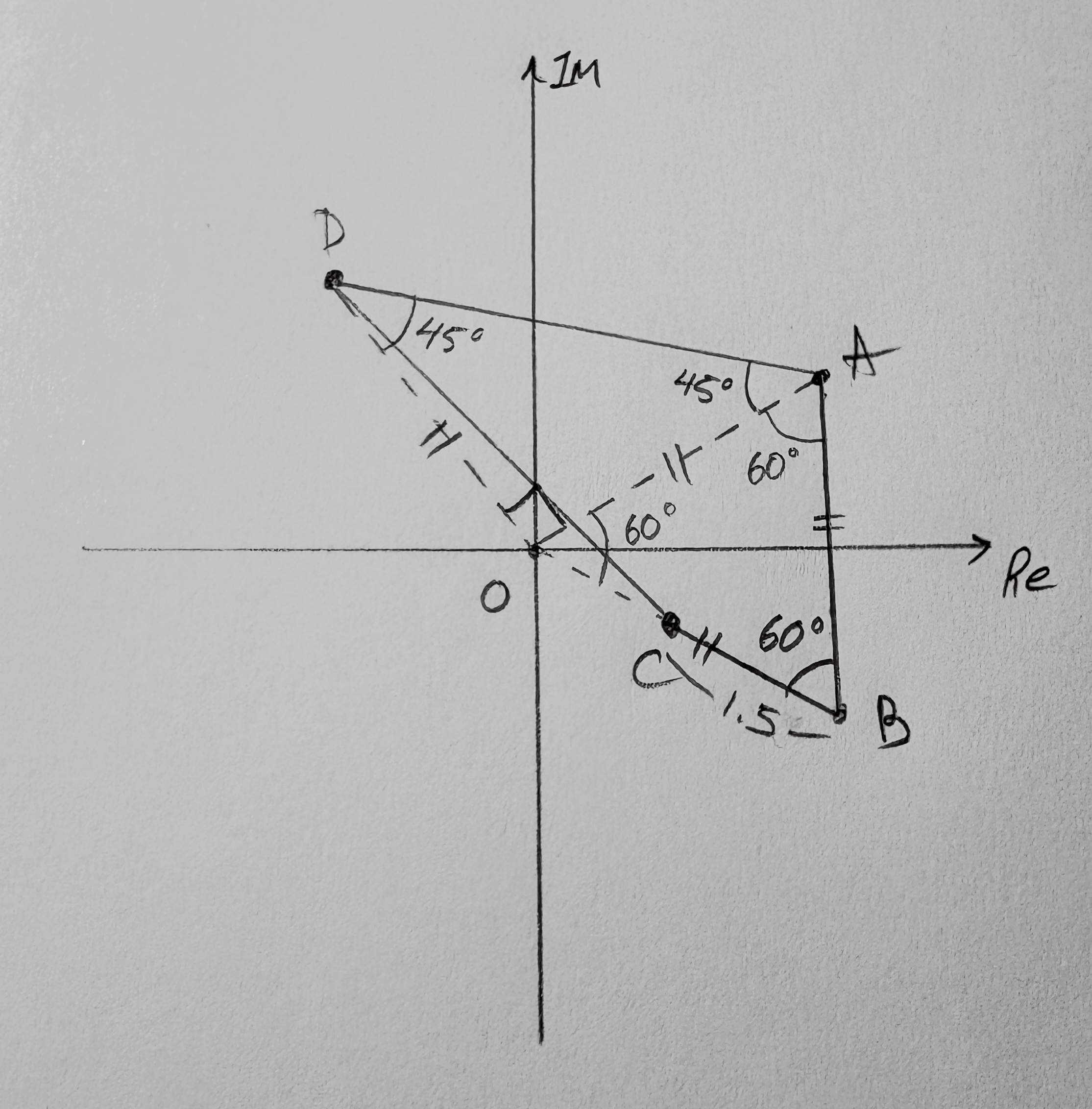
To get the area of ABCD, looks like I can sum the area of ABO and ADO, then subtract that sum by CDO.
AABCD=(AABO+AADO)−ACDO
Get AABO:
A=21absinC
Let CO=x⟹OB=x+1.5
A=21(x+1.5)2⋅sin3π
AABO=43(x+1.5)2
Now get AADO:
A=21(x+1.5)2⋅sin2π
AADO=21(x+1.5)2
Then, get ACDO:
A=21ab⋅sinC
A=21(1.5+x)(x)⋅sinC
Looking at the diagram, I can see that ∠C=90o+30o+30o=150o≡65π
⟹C=65π
Hence
A=2x(x+1.5)⋅21
ACDO=4x(x+1.5)
Now obtaining a formula for AABCD:
AABCD=[43(x+1.5)2+21(x+1.5)2]−[4x(x+1.5)]
After simplification:
A=41+3x2+89+63x+1618+93
Now we need x.
Let x+1.5=r
⟹r−r1=1.5
⟹r2−1.5r−1=0
⟹r=2,−21
But r>1, so r=2
r=2⟹x+1.5=2⟹x=0.5
Now substitute x=0.5 into the area formula:
A=41+3(0.5)2+89+63x+1618+93
AABCD=47+43